
Julie F Hill
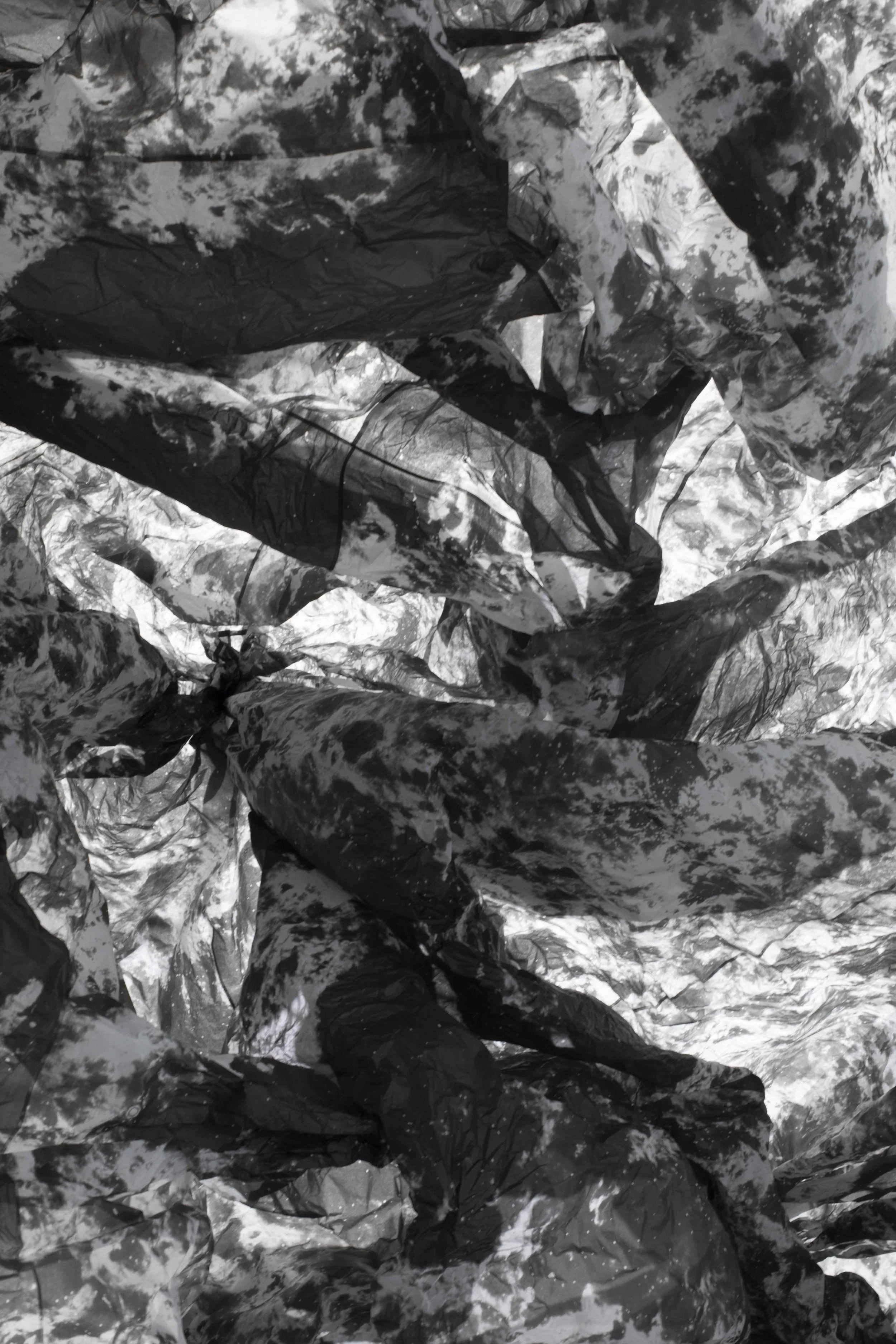
Julie F Hill. From the series, Cave, Rock Clouds and Chasms.
Cave, Rock Clouds and Chasms
Julie F Hill’s research-led practice responds to the vastness of nature as represented by modern science. Taking an expanded approach to photography, she creates sculptural prints and installations that explore conceptions of deep-space and cosmological time. The group of works on display explore the entwined darknesses of deep space and time. Whilst darkness often indicates uncertainty and lack of knowledge, Hill asserts that it is through darkness when we can be most perceptive to the interconnectedness between earth and cosmos.
Cave takes data from the James Webb Space Telescope from barred spiral galaxy NGC 5068, and reworks it into a sculptural installation that emulates a cavernous formation, providing an experience of intimate immensity. The pool beneath is considered akin to an observatory, an instrument for understanding deep space and time. Just as telescopes use mirrors to gather celestial light, the water in Cave reflects and extends the “image”, encouraging contemplation: what ways of knowing could natural telescopes of water and deep earth engender?
Underneath the canopy, Rock Clouds form. Pieces of dolomite are left in a solution to grow aragonite crystals, a form of calcium carbonate, mimicking forms found in caves known as “cave flowers”. Reflected in watery surfaces, they continue to change throughout the duration of the exhibition to eventually sit in dried out channels of mineral residue. The black trays within the installation reference darkroom apparatus. Much like photography, forms and images emerge from chemical and molecular exchanges. Image and form is carried and extended by water and mineral residues, elements that bridge the cosmic and the terrestrial.
Chasms is an ongoing series made by digitally processing RAW data from space telescopes, such as Hubble and the James Webb, using scientific software. Various algorithmic functions are applied to visualise the data, a process Hill likens to a digital darkroom. For this iteration of Chasms, printed data has been left in various solutions to crystallise, fusing celestial light with geological time, whilst also referencing the use of minerals in telescope filters that help us see into parts of the electromagnetic spectrum that are otherwise beyond human vision.