
Hashim Nasr
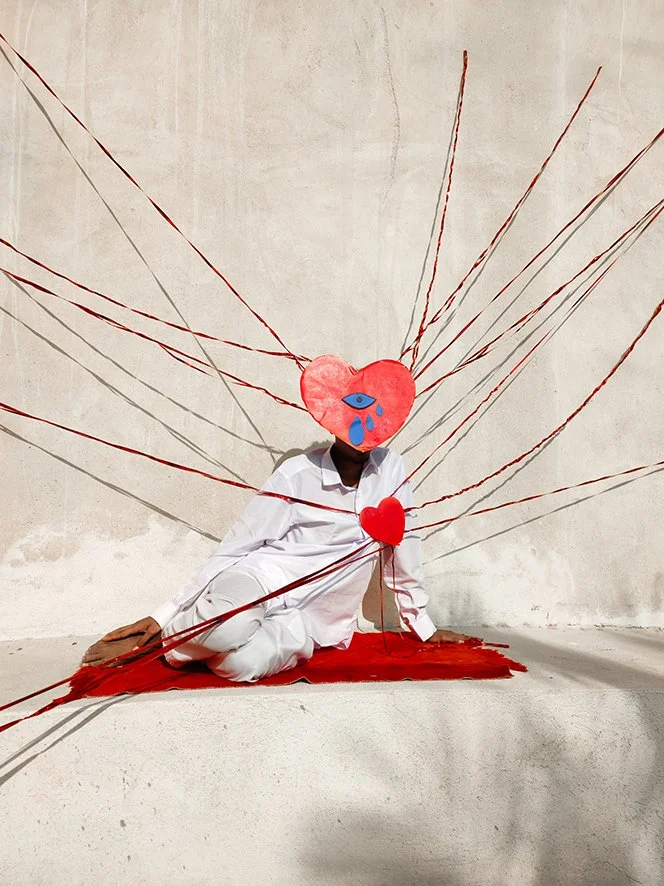
Hashim Nasr. From the series, On War and Displacement.
On War and Displacement
Hashim Nasr is a visual artist whose work explores themes of heritage, identity and conflict through carefully constructed and highly saturated mise-en-scene. Born in Khartoum, Sudan, where he originally trained as a dentist, Nasr has been based in Alexandria, Egypt since 2023. After travelling to Egypt to spend Ramadan at his family’s holiday home, he found himself trapped as the proxy war erupted in Sudan, and unable to return to Khartoum. Today, Nasr is one of over 1.5 million Sudanese to have resettled in Egypt, as a result of the ongoing war.
This project emerges from Nasr’s personal experience of war and displacement, one that extends beyond a singular event into an ongoing condition, reshaping his relationship to place, body, and memory. For many months, Nasr continued to live out of his suitcase, unable to accept that he would not be returning home for the foreseeable future. He threw himself into his visual practice, developing this series of highly stylised, conceptual images that channel his feelings of dislocation, isolation and suspension. Produced from everyday materials, using non-professional models, and shot on a mobile phone, Nasr’s photographs are suffused with symbolism. Faces are consistently masked, suggesting both the obfuscation of identity, and the desire for privacy and anonymity. Figures appear isolated yet interconnected, navigating the liminal zone between an inaccessible past and an uncertain future. The notion of home shifts from a fixed geography to a fragile psychological space, constructed through remembrance, longing, and imagination.
The title, On War and Displacement, is provocative, demonstrating that the material traces of conflict don’t always look how one might imagine. “War is approached not as a distant political moment,” says Nasr, “but as a force that continues to reorganise life even from afar, while displacement becomes an internal state carried within the body.” The work does not attempt to recover what has been lost, but instead reflects on how one lives alongside absence, forming a living archive of displacement.