
Eugenie Shinkle
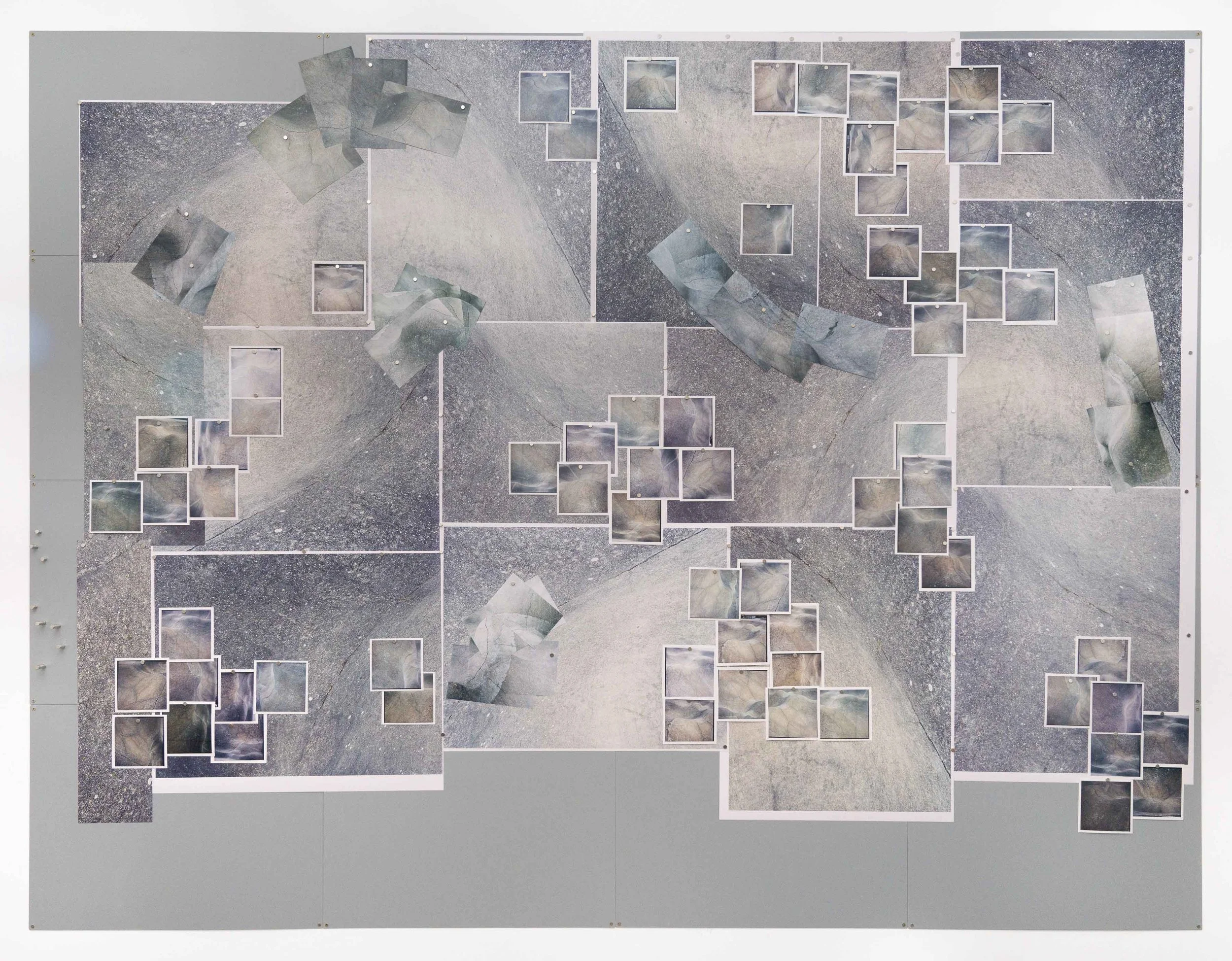
Eugenie Shinkle. From the series, Rom.
ROM
Eugenie Shinkle is a London-based artist and writer whose work explores photography as a durational and embodied encounter. She uses multiple photographic images to build large-scale image fields that reorganise perception across scale, resisting singular viewpoints.
Built in 1978, the Rom skatepark in Hornchurch, Essex was the first of its kind in the UK. No longer in regular use, the concrete structure is slowly decaying – cracking and delaminating, a consequence of decades of weathering, and of the wear and tear inflicted by the passage of thousands of wheels. Though they’re only a few decades old, the forms have a strangely primordial quality, the concrete stained and colonized by lichen, as if the recent past were already slipping into something more geological.
Designed to enable fluid movement through space, the skatepark’s continuous curves and unstable scale challenge the rectilinear logic of conventional architectural photography, disrupting any fixed sense of surface, depth or proportion. Shinkle used three different analogue cameras—a Wista 5x4, a medium-format Rolleicord, and a 35mm Nikon FM2—to photograph the site. The skatepark is not intended to be experienced on foot, and each of these cameras encouraged and enabled a different kind of spatial and temporal reckoning, actively shaping Shinkle’s apprehension of the space. More than just recording the site, the camera structured the conditions under which she encountered it.
This installation takes the form of a large-scale multi-image work in which movement and stillness are not opposed, but coexist. Two adjacent images tumble in multiple iterations and configurations, interrupting any fixed point of orientation. The work does not map a continuous path through the space, but breaks it into fragments that align, slip, and re-form. What emerges is not a single view, but a field in which movement is suggested, interrupted, and repeatedly redirected within the stillness of the image. In those precisely positioned fragments, we see whole galaxies.
ROM does not seek to represent the skatepark as an object, but to reconstruct an experience of it: disorienting, immersive, and at times euphoric. Time is encountered here not as sequence or narrative, but as something embedded in matter and enacted through movement.